
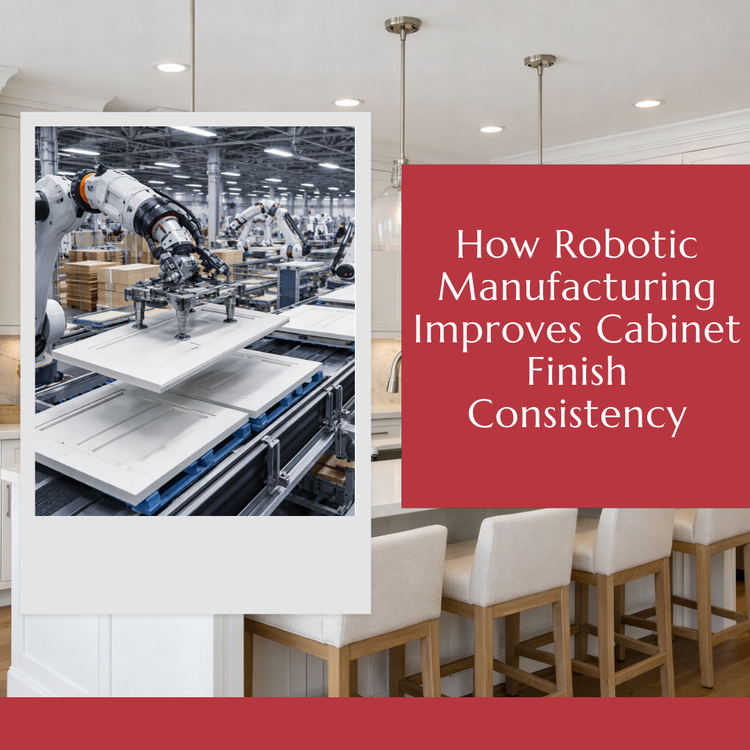
How Robotic Manufacturing Improves Cabinet Finish Consistency
21st Apr 2026
Have you ever opened two cabinet doors side by side and noticed the color is just… a little off? One looks darker. The other has a streak. Maybe the sheen is slightly different on the door.
It’s not your eyes. It’s how the cabinets were made, especially when comparing traditional methods to modern cabinet production.
For a long time, cabinet finishing was a hands-on job. A sprayer would coat the doors, a second person would sand, and a third would inspect. It worked. But humans get tired. Spray patterns change. Temperature and humidity shift through the day. And small differences add up, especially when you’re installing 30 cabinets in one kitchen, even in high-quality kitchen cabinet projects.
That’s the problem robotic cabinet manufacturing, also known as automated cabinet manufacturing, was built to solve. Honestly, it has changed what a kitchen can look like when the last door goes on.
Let’s break down how it works, why it matters, and what it means for contractors, dealers, and homeowners who care about quality from a trusted kitchen cabinet manufacturer.
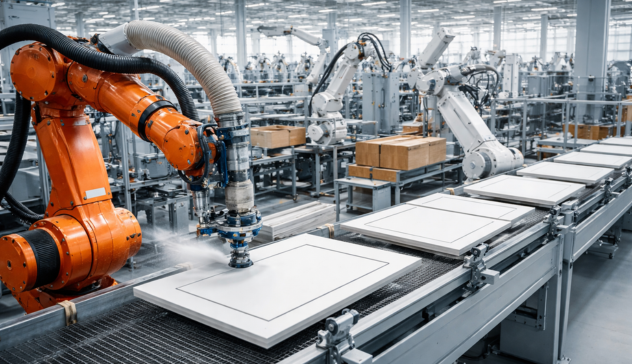
What does “finish consistency” really mean?
Finish consistency, often referred to as cabinet finish consistency, is simple once you look at it closely. It means every door, drawer front, and end panel in your kitchen shares the same:
- Color and tone
- Sheen (matte, satin, or gloss level)
- Smoothness to the touch
- Coverage, no thin spots, no drips, no overspray
When the finish is consistent, the kitchen reads as one clean design. When it’s not, your eye picks up the mismatch even if your brain can’t name it. That shaker door near the window looks a bit lighter. The drawer fronts seem glossier than the uppers. The whole kitchen feels a little “off.”
A consistent finish is one of the biggest reasons a cabinet feels high quality, or doesn’t, especially in factory finished cabinets.
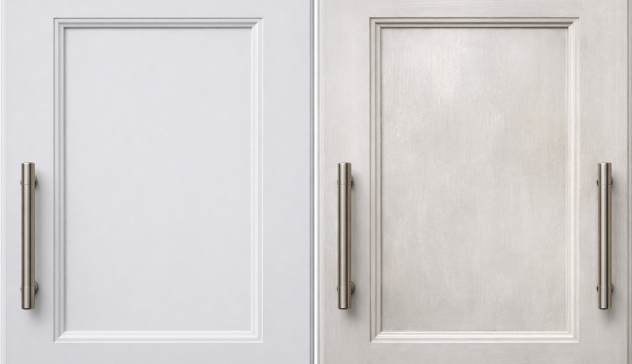
How robotic manufacturing changes the game
Our facility in Bristol, Connecticut, runs 300,000 square feet of automated cabinet production. This level of CNC cabinet manufacturing combines advanced robotics, AI-guided CNC machines, and real-time quality control to ensure every door looks like the next one. Here’s what that actually means on the shop floor.
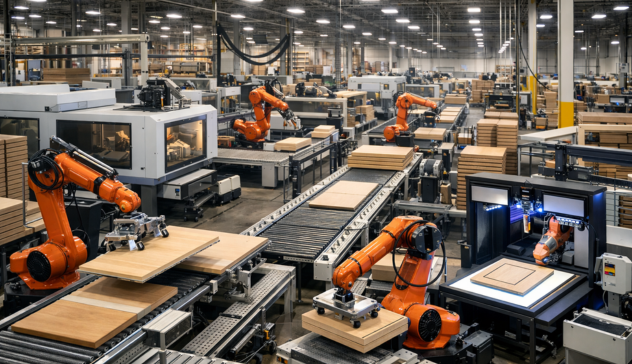
1. Robotic paint systems spray the same way, every time
A human with a spray gun does a good job on door one. Door 200? Their shoulder is tired. Their wrist angle has shifted by a few degrees. The coat thins out.
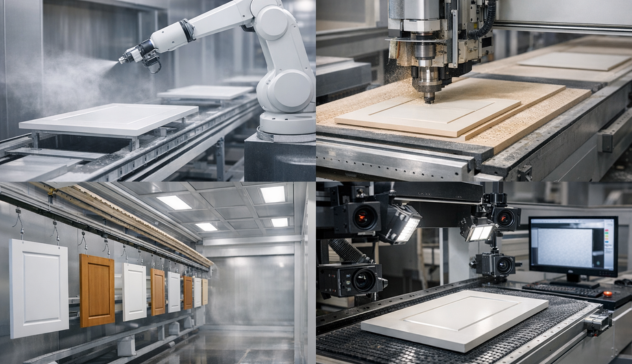
A robotic paint arm moves in the same arc, at the same distance, at the same speed — door one through door ten thousand. The paint flow, the atomization pressure, the overlap between passes — all of it stays locked in. That’s how you get the same color depth and the same smooth surface on every single piece with robotic manufacturing cabinet finishing and precision cabinet finishing.
2. AI-guided CNC cutting removes human error
Before paint ever hits the wood, the door has to be cut. An AI-guided CNC cabinet-making machine reads the design file and cuts each panel to the same tolerance — we’re talking fractions of a millimeter. No wobble. No drift. No end-of-shift fatigue.
Why does that matter for the finish? Because a clean cut gives the finish a clean surface. Rough edges soak up more stain. Unsquare panels create uneven light reflection. When the raw part is perfect, the finish has a fair shot at being perfect too.
3. Climate-controlled spray booths remove the weather
Old-school finishing had a secret enemy: the weather. Humid days made the finish tacky. Cold mornings slowed curing. Spring pollen found its way onto wet doors.
Automated finishing lines run in climate-controlled booths. Temperature, humidity, and airflow are held steady. That means the finish cures the same way in July as it does in January. For dealers and contractors ordering year-round, this is huge. Your March delivery matches your September delivery matches your December delivery, especially when sourcing from factory-direct cabinet suppliers.
4. Real-time quality control catches problems before they ship
Cameras and sensors along the line check each cabinet as it moves through. Is the color within spec? Is the surface smooth? Are the panels cut square?
If something’s off, the system flags it right there. It doesn’t get packed. It doesn’t ship. Your customer never sees it. This is the part that matters most for a cabinet dealer program — because your reputation rides on what shows up at the jobsite.
5. Same recipe, same result, every batch
Robotic manufacturing stores the exact formula for each color and each door style. Three years from now, if a homeowner needs a matching cabinet because they’re adding an island, the system can make it to the same spec. Try matching a hand-sprayed color from 2023. You’ll chase it for weeks.
What this means for homeowners
If you’re renovating your kitchen, this matters more than it sounds.
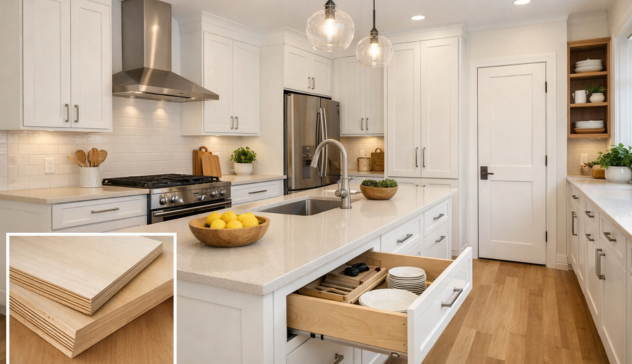
Finish consistency is the difference between a kitchen that photographs well and one that looks patchy in natural light. It’s why your uppers and lowers look like they belong together. It’s why the pantry door doesn’t stand out as “that one weird one.”
You also get a cabinet that holds up. Consistent coats cure evenly. They resist chips, moisture, and fading the same way across the whole kitchen, not great on some doors and thin on others, which is key in high-quality kitchen cabinets.
Add in all-plywood kitchen cabinets, soft-close drawers, and American-made kitchen cabinets, and you’ve got cabinets built to live with your family for twenty years, not twenty months.
What this means for contractors and dealers
For pros, the story gets even better.
Predictable deliveries
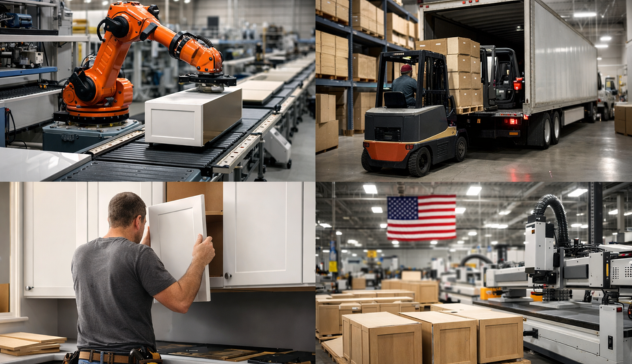
When cabinets are built on a robotic line, you know what you’re getting before the truck shows up. No surprise color shifts. No “we’ll have to reorder that end panel.” That kind of predictability is why our cabinets ship in about 2 weeks, not the 14-week industry average, ideal for wholesale kitchen cabinets buyers.
Fewer reorders, fewer callbacks
Every reorder costs you time, money, and customer trust. Consistent finishing cuts that number down. The box you opened last month and the one you open today look identical. Your installer doesn’t have to sort doors by tone before hanging them.
A better story to sell
Dealers in our Kunal Kitchens program tell us this a lot: it’s easier to sell a cabinet when you can point to how it’s made. 300,000 square feet of robotic manufacturing. AI-guided CNC. Real-time quality checks. All-plywood boxes. Made in the USA. That’s not a marketing pitch, that’s six real reasons a customer should feel good about their purchase from a trusted kitchen cabinet manufacturer.
Robotic doesn’t mean cold — it means consistent
A fair question: Does all this automation take the craft out of cabinets?
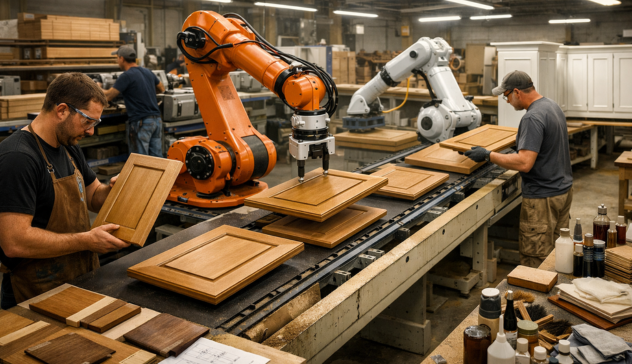
Not really. The craft just moves. Skilled people still design the cabinets, set up the lines, choose the wood, tune the finishes, and inspect the work. Robots don’t replace craftsmanship; they protect it. They make sure the thing a master designed in the morning still looks like that master’s work on door number 800.
When it comes to cabinet quality, most people focus on style, color, or price. But what truly separates an average kitchen from a high-end one is consistency — how every single door, drawer, and panel looks and feels together. That’s exactly where robotic manufacturing makes a real difference.
From perfectly even paint application to precision-cut panels and controlled finishing environments, automation removes the small inconsistencies that the human eye instantly notices. The result is a kitchen that looks clean, cohesive, and professionally finished from every angle — not just on day one, but for years to come.
If you’re looking for cabinets that deliver this level of quality every time, explore Kunal Kitchens. Their collection combines factory-level precision, modern design, and dependable supply — making it easier to deliver kitchens that look perfect not just on day one, but for years to come.
FAQ’s
1. What is cabinet finish consistency and why does it matter?
Cabinet finish consistency means every door, drawer, and panel has the same color, sheen, and smoothness. It matters because even small differences in finish can make a kitchen look uneven or lower quality, especially in natural light.
2. Are factory-finished cabinets better than hand-finished cabinets?
Factory-finished cabinets are generally more consistent because they are produced in controlled environments using automated systems. This reduces variations in color, texture, and coating thickness compared to hand-finished cabinets.
3. How does robotic manufacturing improve cabinet quality?
Robotic manufacturing improves cabinet quality by applying finishes evenly, cutting materials with high precision, and maintaining controlled conditions throughout production. This results in smoother surfaces, better durability, and consistent appearance across all cabinets.
4. Do robotic-finished cabinets last longer?
Yes, cabinets finished using automated systems tend to last longer because the coating is applied evenly and cured properly. This helps prevent issues like chipping, fading, or uneven wear over time.
5. What should I look for in high-quality kitchen cabinets?
Look for all-plywood box construction, soft-close hinges and drawer slides, and a consistent factory-applied finish. Also check for smooth surfaces, even color across all panels, and strong warranty support from the manufacturer.